
Table of Contents
Germany is filled with beautiful places: medieval towns, peaceful forests, romantic castles, vineyard-covered hills, and broad rivers that have shaped the country’s history. Yet if one destination deserves to be called Germany’s most beautiful, Berchtesgaden in southeastern Bavaria is a compelling choice.
Tucked against the Austrian border, Berchtesgaden combines everything travelers imagine when they dream of the perfect Alpine escape. Towering mountains rise above deep green valleys. Clear lakes reflect cliffs and forests like polished glass. Wildflower meadows spread across the hillsides, while traditional villages preserve the warmth, architecture, and character of Bavaria.
At the heart of this landscape lies Berchtesgaden National Park, Germany’s only national park in the Alps. Its guiding philosophy is simple: allow nature to remain as wild and undisturbed as possible. The park covers approximately 210 square kilometres and is known for its rugged peaks, mountain forests, alpine pastures, and exceptionally clear lakes. [1]
Berchtesgaden is not merely beautiful in a postcard sense. It is a place where the landscape feels alive, powerful, and almost timeless—a destination that can make visitors slow down, breathe more deeply, and remember how much wonder can exist beyond busy cities and crowded streets.

🌲 A Landscape Designed by Nature
Berchtesgaden’s beauty comes from the extraordinary variety of its scenery. Within a relatively compact region, visitors can experience high mountain ridges, peaceful valleys, dense forests, waterfalls, caves, lakes, historic villages, and open alpine meadows.
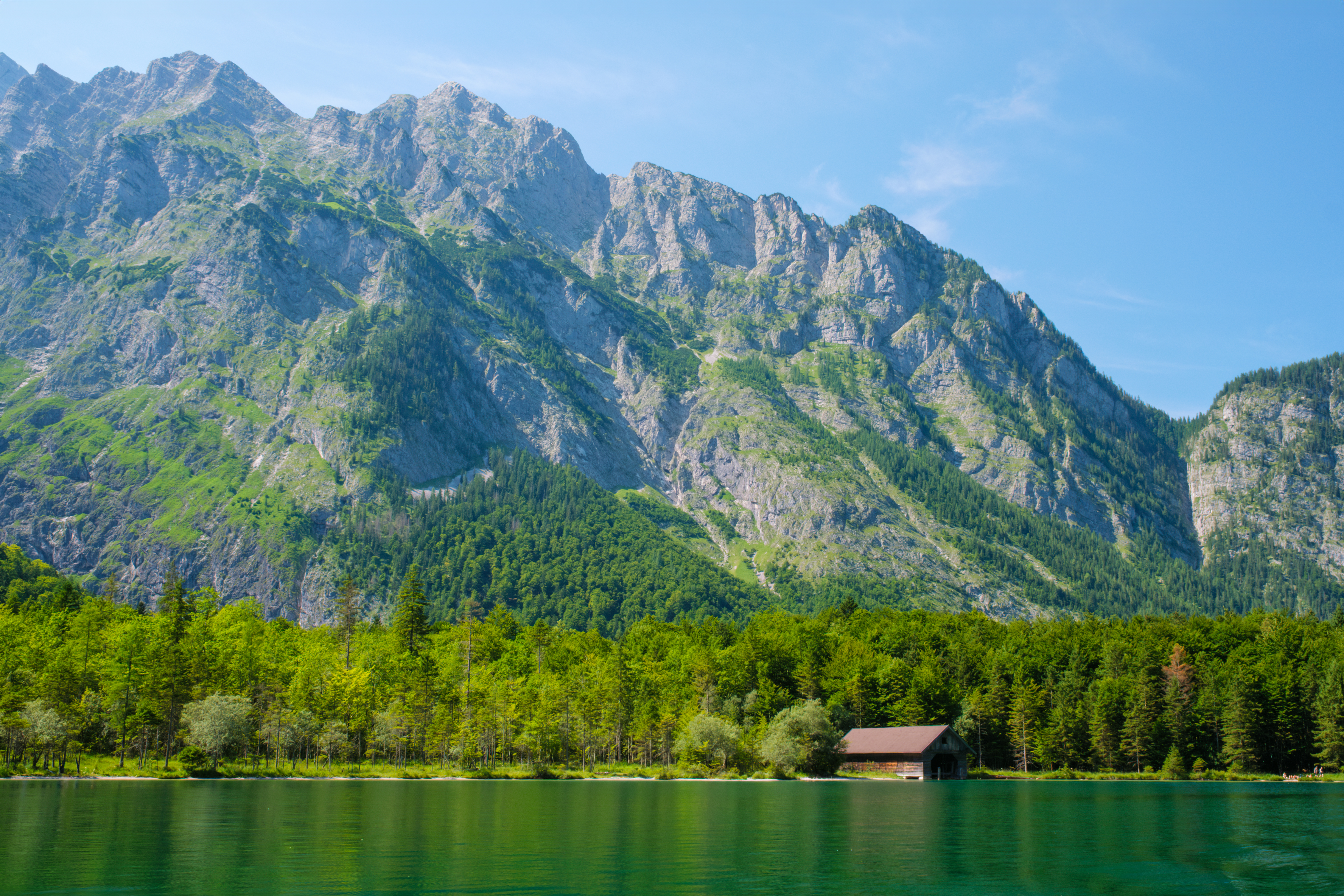
The mountains are part of the Northern Limestone Alps, a range shaped over millions of years by geological forces, glaciers, rain, ice, and flowing water. Their pale rock faces contrast dramatically with the dark green of the forests and the rich blue of the sky.
The most recognizable mountain in the region is the Watzmann. Rising to 2,713 metres, it dominates the local skyline and has become one of Bavaria’s most famous natural landmarks. Its distinctive form, including several prominent peaks, has inspired legends, paintings, photographs, and countless hiking routes.
The Watzmann is more than a mountain in the background. It gives the entire region a sense of identity. From the streets of Berchtesgaden, from the shores of Königssee, and from the surrounding hills, its presence creates a dramatic visual anchor that makes the landscape instantly recognizable.

💧 Königssee: The Jewel of Bavaria
If Berchtesgaden is Germany’s mountain paradise, Königssee is its shining centrepiece.
The name Königssee means “King’s Lake,” and the lake lives up to its royal name. Surrounded by steep mountain walls and dense forests, its long, narrow shape resembles a natural cathedral carved into the Alps. The water is famous for its remarkable clarity, while the mountains rise sharply from the shoreline, creating views that appear almost too perfect to be real.
One of the best-known ways to experience Königssee is by taking an electric boat across its calm waters. The boats move quietly, allowing visitors to hear the wind, the water, and the echo that travels across the cliffs. During the journey, boat captains traditionally demonstrate the famous Königssee echo by playing a trumpet across the lake. The sound travels toward the mountains and returns several seconds later, creating one of the region’s most memorable experiences.
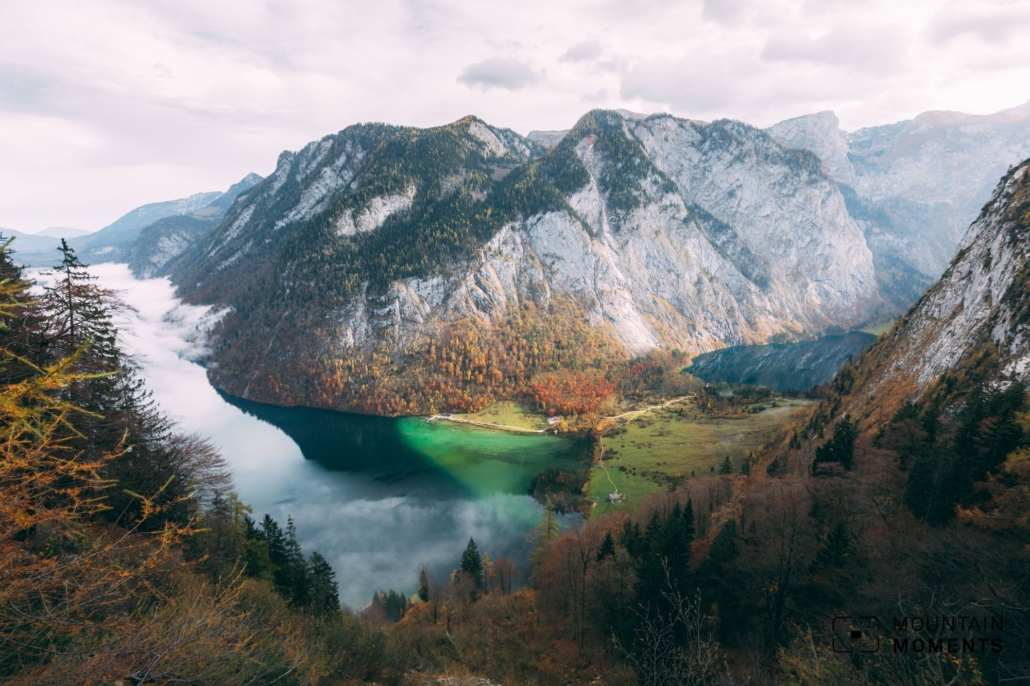
The boat journey commonly leads toward St. Bartholomä, a small pilgrimage church distinguished by its red onion-shaped domes. Set against the massive mountains, the church is one of the most photographed landmarks in Bavaria.
The view is especially beautiful in the early morning, when mist may float above the water and the mountains are reflected in the lake’s surface. Later in the day, sunlight moves across the cliffs, revealing changing shades of grey, green, and gold.
⛪ St. Bartholomä and the Spirit of the Lake
St. Bartholomä is not simply a beautiful building beside the water. It is a symbol of the relationship between history, faith, and the natural world in Berchtesgaden.
The church’s distinctive red domes stand out against the surrounding mountains. Its location on the western shore of Königssee gives it an almost dreamlike appearance. Visitors arrive by boat, step onto the shore, and find themselves surrounded by steep cliffs, forested slopes, and the quiet movement of the lake.
The church has long attracted pilgrims and travelers. Its presence adds a human story to a landscape that might otherwise seem untouched by civilization. The result is an unusual harmony between architecture and nature: the building does not overpower the scenery but seems to belong to it.
Around St. Bartholomä, visitors can enjoy short walks, peaceful viewpoints, and restaurants serving traditional Bavarian food. Local dishes may include pretzels, soups, dumplings, sausages, and freshwater fish. In such surroundings, even a simple meal can feel like an important part of the journey.
🥾 Hiking Through the National Park
Berchtesgaden National Park is a destination for people who want more than scenic photographs. Its trails offer the opportunity to experience the region slowly and physically, one step at a time.
Some routes are gentle and suitable for relaxed walks through forests or along lake shores. Others climb into the high mountains and require stronger preparation, proper footwear, navigation skills, and awareness of changing weather.
A walk through the park can reveal details that are easy to miss from a vehicle or boat. Sunlight moves through the trees. Water flows over stones. Mountain birds call from hidden slopes. Wildflowers grow among the grasses, and distant peaks appear between openings in the forest.
The park is home to a range of alpine wildlife, including chamois, red deer, marmots, golden eagles, and ibex. Some animals are difficult to spot, but their presence contributes to the feeling that the mountains are still governed by their own rhythms.
The National Park’s philosophy emphasizes allowing natural processes to continue. Fallen trees, changing river channels, and areas of forest left to develop naturally are not viewed as signs of neglect. They are part of the ecosystem’s life cycle.
This approach creates a different kind of beauty. It is not the carefully arranged beauty of a garden. It is the beauty of a living landscape—uneven, seasonal, unpredictable, and constantly changing.

🦌 Wildlife in a Living Mountain Environment
The mountains around Berchtesgaden provide habitats for many species that have adapted to steep terrain, cold winters, thin mountain air, and changing seasons.
Chamois move across rocky slopes with remarkable agility. Marmots emerge during warmer months and can often be heard whistling to warn one another of danger. Golden eagles soar above the valleys, using rising air currents to remain aloft with little visible effort.
Red deer inhabit the forests and meadows, while smaller animals live among rocks, shrubs, and alpine grasses. The presence of these creatures reveals the importance of protecting large, connected natural areas.
Visitors are encouraged to observe wildlife from a respectful distance. The best encounters are usually quiet ones: a fleeting shape between trees, movement on a distant ridge, or the sound of an animal hidden somewhere beyond the trail.
The purpose of visiting a national park is not to control nature but to witness it. Berchtesgaden rewards patience. The longer a person remains still, the more the landscape seems to reveal.
🌄 Jenner Mountain and the View from Above
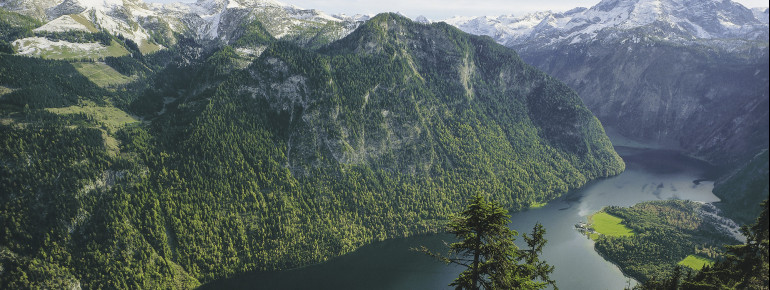
For one of the most impressive panoramic views in the region, many visitors travel toward Jenner Mountain. From the higher elevations, the landscape opens into a vast arrangement of peaks, valleys, forests, and water.
Königssee can be seen below, appearing narrow and bright between the mountains. The Watzmann rises across the surrounding landscape, while the Austrian Alps stretch into the distance.
The view changes dramatically with the weather. On a clear day, the mountains may appear sharply defined, with every ridge and valley visible. On a cloudy day, mist may move across the slopes, hiding and revealing the peaks in slow succession.
Sunrise and sunset are especially memorable. In the morning, the first light touches the higher summits before reaching the valleys below. In the evening, the rock faces may turn shades of orange, pink, and violet.
These moments are reminders that the beauty of Berchtesgaden is not fixed. It changes with the hour, the season, the clouds, and the angle of the sun.
🏡 The Charm of Berchtesgaden Town
Although the mountains are the region’s greatest attraction, the town of Berchtesgaden has a character of its own.
The town centre features traditional Bavarian architecture, painted façades, decorative balconies, churches, small shops, cafés, and restaurants. Many buildings reflect the region’s long history and connection to the surrounding mountains.
Walking through Berchtesgaden is a pleasant contrast to hiking in the national park. Instead of rocky trails and forest paths, visitors find narrow streets, public squares, historic buildings, and the comfortable rhythm of local life.
The town is also a practical base for exploring the wider area. From here, travelers can reach Königssee, mountain trails, viewpoints, salt mines, nearby villages, and other attractions throughout the Berchtesgadener Land region.
A visit to the town allows travelers to experience Bavaria not only as a landscape but also as a culture. Traditional clothing, music, food, festivals, crafts, and local customs remain important parts of the region’s identity.
🧂 The Salt Mines Beneath the Mountains
One of the most fascinating aspects of Berchtesgaden is that its story continues underground.
The region has a long history of salt mining. Salt was once an extraordinarily valuable resource, essential for preserving food and supporting trade. Beneath the mountains, miners created tunnels and chambers in search of deposits that helped shape the local economy.
Today, visitors can explore parts of the historic salt-mining world through guided tours. These experiences reveal a side of Berchtesgaden that is very different from its lakes and mountains.
The contrast is striking. Above ground, the region is defined by sunlight, forests, and open views. Below ground, it becomes a world of darkness, carved passageways, underground lakes, and industrial history.
The salt mines provide an important reminder that beautiful landscapes are also working environments. For centuries, local communities depended on the resources hidden beneath the mountains.
🏰 History Written Into the Landscape
Berchtesgaden’s history is complex and layered. Religious communities, mountain farmers, miners, merchants, rulers, and travelers have all contributed to the region’s story.
The landscape encouraged settlement in valleys and sheltered areas, while the mountains shaped transportation, agriculture, and local traditions. Alpine farming remains visible in the meadows and seasonal pastures, where livestock graze during the warmer months.
Traditional mountain huts, known as alpine huts, are an important part of the countryside. Some provide food and shelter for hikers, while others continue to support local farming practices.
These huts are often modest buildings, but they contribute greatly to the character of the region. A wooden structure surrounded by grass, wildflowers, and mountain peaks can communicate the essence of Bavaria more powerfully than a grand monument.
Berchtesgaden also carries the difficult history of the twentieth century. The nearby Obersalzberg area was used by Nazi leaders, and the documentation centre there examines the history of the site and the crimes of the Nazi regime. Visiting this location provides an essential historical perspective and shows why beautiful places must not be separated from the events that occurred within them.
🍽️ The Taste of Bavaria
A journey through Berchtesgaden is also a journey through Bavarian cuisine.
Traditional meals are often hearty, comforting, and designed for people who have spent time outdoors. Visitors may encounter dishes such as käsespätzle, a rich cheese-based noodle dish; potato dumplings; roasted meats; sausages; soups; freshwater fish; and warm apple desserts.
The famous Bavarian pretzel is a natural companion to almost any meal. Large, soft, and lightly salted, it is often served with mustard, cheese, or local spreads.
Food in Berchtesgaden reflects the region’s agricultural traditions. Dairy products, bread, potatoes, herbs, and meat have long played important roles in local cooking.
A meal tastes different after a day in the mountains. Hunger sharpens appreciation, and the setting adds to the experience. A simple dish enjoyed outside a mountain hut, with the Alps rising behind it, can become one of the strongest memories of a trip.
🌦️ The Beauty of Every Season
Berchtesgaden changes completely throughout the year.
🌸 Spring
In spring, snow begins to retreat from the lower slopes, streams fill with melting water, and the first wildflowers appear. The landscape feels fresh and renewed. Waterfalls become especially powerful, and the valleys begin to brighten with new leaves.
☀️ Summer
Summer brings long days, green meadows, open hiking trails, and comfortable conditions for exploring. It is the busiest season, but the mountains are large enough to offer moments of solitude away from the most popular sites.
🍂 Autumn
Autumn may be the most atmospheric season in Berchtesgaden. Forests turn gold, orange, and red, while the cooler air creates sharp visibility across the valleys. The combination of colourful trees, blue lakes, and grey mountain peaks is extraordinary.
❄️ Winter
Winter transforms the region into a quiet Alpine world. Snow covers the forests, rooftops, and mountain paths. The cold air makes the landscape feel still and spacious, while villages glow with warm lights.
Each season reveals a different identity. Berchtesgaden is not a destination that needs to be seen only once because its character changes constantly.
📸 Why Berchtesgaden Is a Photographer’s Dream
Berchtesgaden offers an extraordinary range of subjects for photographers.
There are reflections on Königssee, mist above the valleys, weathered wooden barns, mountain churches, wild animals, forest trails, alpine flowers, distant peaks, and dramatic changes in light.
The region is particularly photogenic because it combines scale and detail. A wide landscape photograph can show the immense size of the mountains, while a close-up image can reveal the texture of tree bark, the shape of a flower, or droplets of water on a moss-covered stone.
Early morning is often the best time for photography. The light is softer, the air may be clearer, and popular viewpoints are usually quieter. Late afternoon and evening also bring beautiful colours, especially when the sun strikes the mountains from the side.
However, the most meaningful photographs are not always the most dramatic. A photograph of a quiet trail, an empty bench, or a distant church may communicate the feeling of Berchtesgaden more effectively than a perfectly composed panorama.
🌿 A Place That Encourages Slow Travel
One of Berchtesgaden’s greatest qualities is that it rewards travelers who do not rush.
It is possible to visit the major attractions quickly, take a few photographs, and leave with the impression that the region is beautiful. But a slower visit allows the landscape to become more personal.
Take time to sit beside the lake. Walk without constantly checking the distance. Listen to the sound of water moving over stones. Pause in a meadow and watch clouds change the appearance of the mountains.
Slow travel also encourages greater respect for the environment. Walking, using public transportation where possible, staying on marked trails, and avoiding unnecessary disturbance helps protect the landscape for future visitors and for the wildlife that depends on it.
The best travel memories often come from moments that were not planned: a sudden break in the clouds, a quiet path discovered by accident, or the sight of sunlight touching a mountain peak.
🧭 Practical Advice for Visitors
A visit to Berchtesgaden is most enjoyable when planned with the region’s geography and weather in mind.
Comfortable walking shoes are essential, even for travelers who do not intend to undertake difficult hikes. Mountain weather can change rapidly, so a waterproof jacket, warm layer, sunscreen, water, and basic snacks are useful throughout the year.
Visitors should check trail conditions before beginning a hike. Some routes may be closed because of snow, storms, rockfall, or seasonal maintenance.
The most popular attractions can become busy during summer and holiday periods. Arriving early is often the best way to enjoy a quieter experience, especially at Königssee.
Respect for nature is also important. Travelers should avoid leaving marked trails, feeding wildlife, picking protected plants, or leaving behind rubbish. The beauty of Berchtesgaden depends on careful stewardship.
✨ Why Berchtesgaden Deserves the Title
Calling any place “the most beautiful in Germany” is ultimately subjective. Some people may prefer the romantic streets of Rothenburg ob der Tauber, the cliffs of the Baltic coast, the forests of the Black Forest, or the fairytale towers of Neuschwanstein.
But Berchtesgaden makes an unusually strong claim because it offers so much in one place. It has dramatic mountains, clear lakes, wildlife, traditional villages, historic churches, alpine food, hiking trails, underground salt mines, and a national park dedicated to protecting natural processes.
Its beauty is not limited to one viewpoint. It continues around every bend in the road, along every forest trail, and across every changing reflection on the lake.
Berchtesgaden is beautiful in the obvious way, with grand mountains and spectacular scenery. It is also beautiful in quieter ways: in the sound of a church bell across the valley, the smell of rain on a forest path, the warmth of a meal after a long hike, and the stillness of a lake surrounded by stone.
🌄 A Final Reflection

Berchtesgaden is the kind of place that remains in the mind long after the journey has ended.
Visitors may forget the exact names of every trail or viewpoint, but they remember the feeling of standing beside Königssee. They remember the mountains rising above the water, the echo crossing the cliffs, the church domes glowing in the sunlight, and the sense that the landscape was both powerful and peaceful.
In a world filled with noise, movement, and constant distraction, Berchtesgaden offers something increasingly rare: the chance to be completely present.
It is a place where nature does not need to compete for attention. The mountains speak for themselves. The lakes hold the sky. The forests move with the seasons. And somewhere between the valley and the summit, visitors may discover that the most beautiful destination is not only a place they see—it is a place that changes the way they feel.
Berchtesgaden may not be the only beautiful place in Germany, but it is one of the most complete expressions of the country’s natural beauty: wild, peaceful, dramatic, welcoming, and unforgettable.