
Table of Contents
🇮🇪 Ireland is a country of extraordinary landscapes. Its green hills, ancient ruins, quiet lakes, windswept beaches, stone villages, and dramatic coastlines have made it one of Europe’s most beloved destinations.
There are many places in Ireland that could reasonably be called the most beautiful. Killarney National Park is famous for its lakes and mountains. The Ring of Kerry offers winding roads through some of the country’s most impressive scenery. Connemara is known for its remote beauty, while the Dingle Peninsula combines rugged coastlines with traditional Irish culture.
However, one region stands above the rest for its combination of drama, history, wildlife, and natural beauty: the Wild Atlantic Way, especially the area surrounding the Cliffs of Moher and the Burren in County Clare.
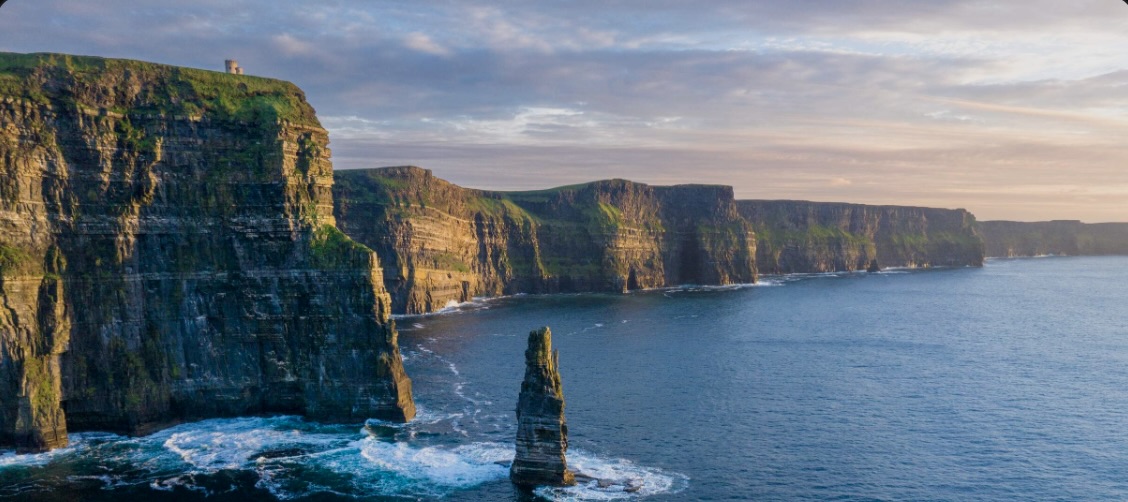
The Wild Atlantic Way follows Ireland’s western coastline for approximately 2,500 kilometres, making it one of the longest defined coastal touring routes in the world. Along the route, travelers encounter sea cliffs, sandy beaches, islands, fishing villages, mountains, archaeological sites, and landscapes shaped by the Atlantic Ocean. [1]

This is Ireland at its most powerful. The coast is beautiful, but it is not delicate. Waves strike the cliffs with tremendous force. Wind moves across the grasslands. Clouds race above the ocean. The landscape feels ancient, open, and alive.
🌊 The Atlantic Ocean and Ireland’s Western Edge
Ireland’s western coast faces the Atlantic Ocean, and that location has shaped the character of the entire region.
The Atlantic is responsible for much of the coast’s rugged appearance. Over thousands of years, waves, wind, rain, and erosion have carved the land into cliffs, caves, arches, beaches, and rocky headlands.
The sea also influences the region’s weather. Conditions can change quickly, with sunshine giving way to mist or rain within minutes. Although the weather may sometimes be unpredictable, it contributes to the atmosphere of the landscape. A cloudy sky can make the cliffs appear mysterious, while sunlight can turn the sea into a brilliant sheet of blue.
The western coast is not beautiful because it is always calm. It is beautiful because it reveals nature in motion. The ocean is constantly reshaping the shoreline, and every tide changes the appearance of the rocks below.
Along the coast, visitors may see seabirds circling above the cliffs, seals resting near sheltered beaches, and dolphins moving through offshore waters. The landscape is not only a place to admire; it is also a habitat filled with life.

🏞️ The Cliffs of Moher: Ireland’s Most Famous Coastal View
The Cliffs of Moher are among the most recognizable natural landmarks in Ireland.
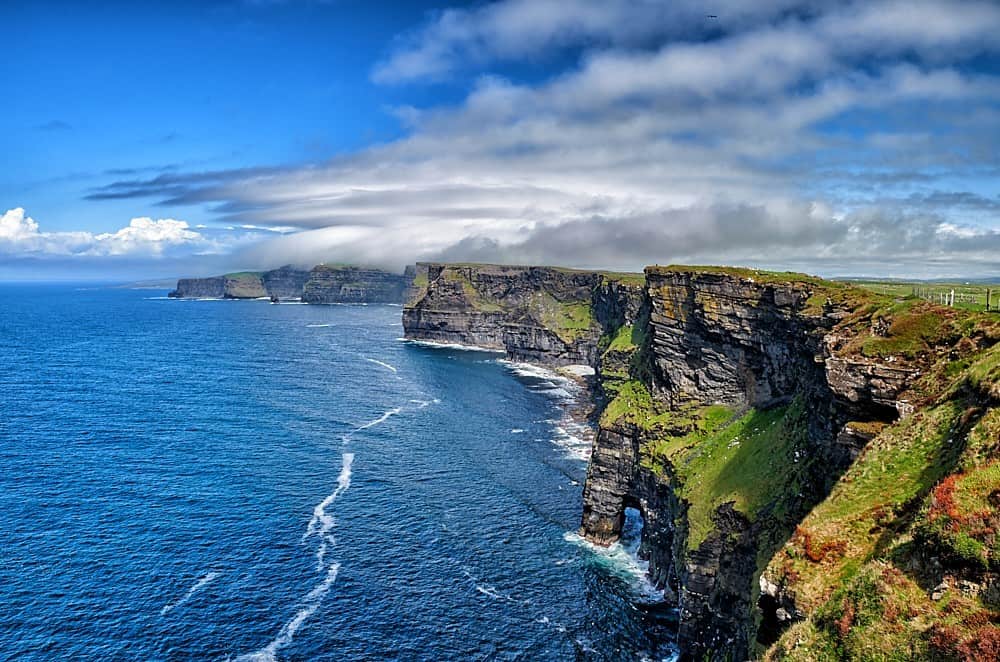
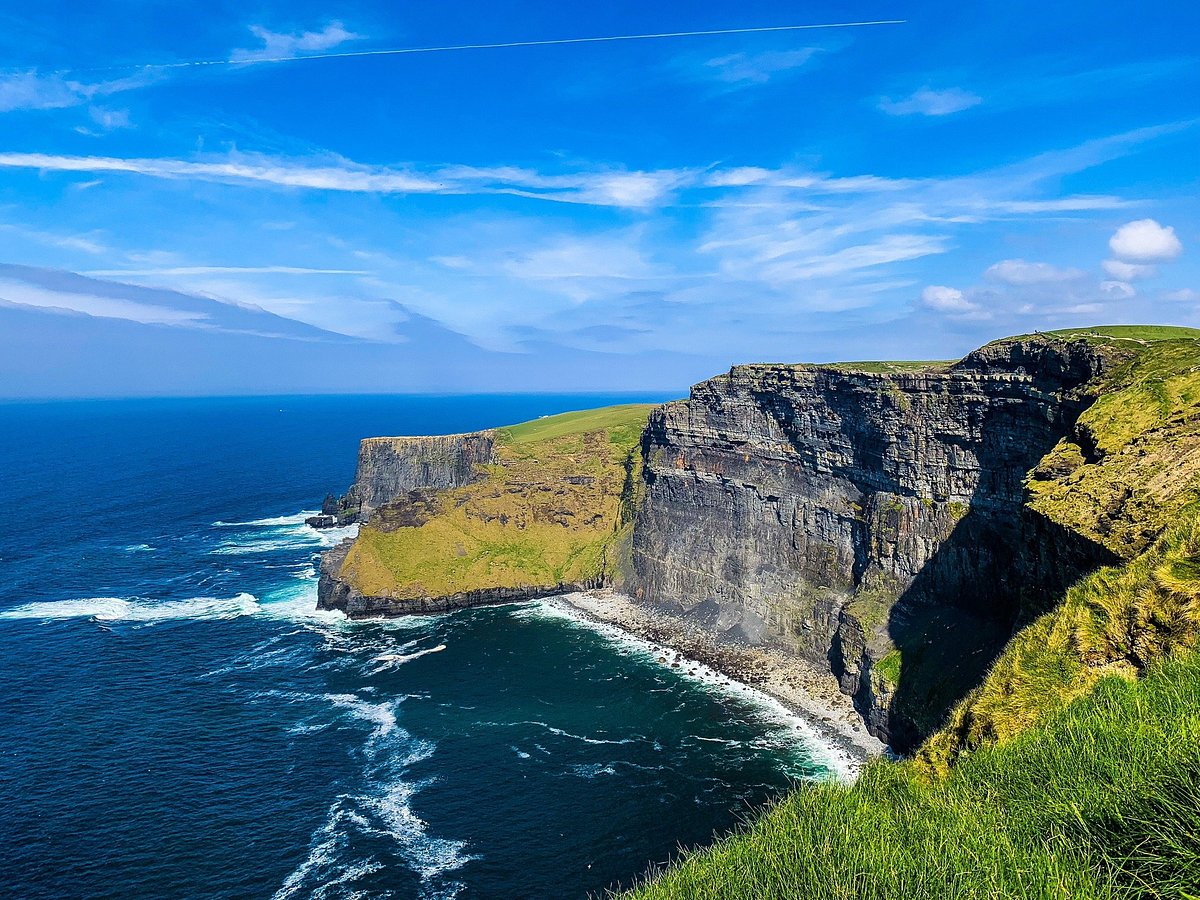
Located on the western edge of County Clare, the cliffs rise dramatically above the Atlantic Ocean. Their dark sandstone and shale layers create a powerful contrast with the green grass that grows along the upper edges.
The cliffs extend for approximately 14 kilometres and reach their greatest height near the northern end, where they rise to about 214 metres above the sea. Their scale is difficult to understand from photographs. Standing at the edge, visitors can see the enormous vertical drop, the waves far below, and the long line of cliffs continuing into the distance.
The cliffs were formed from sedimentary rock deposited in an ancient marine environment. Over immense periods of time, geological forces created the layers that are visible today. The cliffs therefore reveal part of Ireland’s deep natural history, with each horizontal band of rock representing a different stage in the formation of the landscape.
The most famous viewpoint is near O’Brien’s Tower, a nineteenth-century observation tower built close to the highest part of the cliffs. From this area, visitors can look north toward Hags Head and south toward the Aran Islands, depending on the weather and visibility.
The view is especially dramatic when the sea is rough. Waves rise against the cliff faces and break into white spray, while the sound of the ocean echoes across the stone. On calmer days, the water appears deep blue or green, and the cliffs seem to float above the surface.
🐦 A Sanctuary for Seabirds
The Cliffs of Moher are not only a major tourist attraction. They are also an important habitat for seabirds.
The cliffs provide nesting sites for species that depend on steep rock faces and access to the ocean. Depending on the season, visitors may see puffins, razorbills, guillemots, fulmars, kittiwakes, and peregrine falcons.
During the breeding season, the cliff faces become busy with movement. Birds return to their nests, call to one another, and fly between the rocks and the sea. Their presence adds sound and motion to the landscape.
The puffin is one of the most popular birds associated with the cliffs. With its colourful bill and upright posture, it is easily recognized, although it may not always be visible from the main viewing areas.
The best way to observe wildlife is to remain quiet, stay on designated paths, and avoid approaching nesting areas. The cliffs are exposed and potentially dangerous, so visitors should never stand too close to unprotected edges.
The birdlife also demonstrates how closely connected the land and sea are. The cliffs provide shelter and nesting space, while the ocean supplies food. Protecting one part of the environment helps protect the entire coastal system.
🌿 The Green Fields Above the Cliffs
One of the most beautiful features of Ireland’s western coast is the contrast between the bright green fields and the dark Atlantic below.
The grasslands above the cliffs are shaped by Ireland’s mild, wet climate. Rainfall supports dense vegetation, while the coastal wind prevents trees from growing in many exposed areas.
The result is an open landscape that seems to stretch without interruption. Stone walls divide many fields, creating patterns that reflect generations of farming. These walls were built from local stone and often follow the natural contours of the land.
The green colour of the countryside is not uniform. It changes with the weather and the season. After rain, the fields may appear intensely bright. Under cloud, they can become deeper and more muted. In the evening, low sunlight may give the grass a golden appearance.
Visitors often associate Ireland with green scenery, but the coast shows why the colour is so vivid. The combination of rain, ocean air, soft light, and fertile ground creates a landscape unlike almost anywhere else.
🪨 The Burren: A Landscape of Stone and Flowers
Not far from the Cliffs of Moher lies the Burren, one of Ireland’s most unusual landscapes.
The Burren is a karst landscape formed mainly from limestone. Its exposed rock surfaces create broad pavements divided by deep cracks known as grikes. At first glance, the area may seem barren, but the limestone supports an extraordinary variety of plant life.
The Burren is famous because plants from different environments grow unusually close together. Alpine, Mediterranean, Arctic, and temperate species can all be found in the region. This unusual mixture is made possible by the local geology and climate.
During spring and summer, delicate flowers grow among the limestone cracks. Orchids, gentians, mountain avens, and other plants add colour to the pale stone. The sight is remarkable because the vegetation appears in a landscape that seems, from a distance, too rocky to support it.
The Burren teaches visitors not to judge a landscape too quickly. What may initially appear empty is actually one of the most biologically diverse areas in Ireland.

🏺 Ancient History Across the Landscape
Ireland’s western coast is filled with signs of human history.
Ancient stone structures, burial monuments, ring forts, churches, castles, and ruined settlements can be found throughout the region. These sites reveal how people lived, worshipped, farmed, defended their communities, and travelled across the landscape.
One of the best-known ancient monuments in the Burren is Poulnabrone Dolmen, a portal tomb built during the Neolithic period. The monument consists of large limestone slabs arranged to create a stone chamber. Archaeological investigations found human remains and evidence that the site was used for burial thousands of years ago.
Poulnabrone is impressive not only because of its age but also because of its setting. The monument stands in the open Burren landscape, surrounded by pale limestone and distant hills. Its simplicity makes it powerful. There are no grand walls or elaborate decorations. The structure consists of a few enormous stones, yet it has survived for generations.
Other sites across the region include ancient forts and ecclesiastical ruins. Their presence shows that the western landscape has long been connected to human life. The cliffs and hills may seem remote, but they have always been part of a lived environment.
🏰 Castles, Ruins, and Irish Memory
Ireland’s ruins are among its most photographed features, and the Wild Atlantic region contains many examples.
Stone castles were built for protection, residence, and control of the surrounding land. Some stand beside rivers, while others occupy rocky heights or overlook the sea. Many have survived only partially, but their broken walls continue to define the landscape.
The ruins of Irish castles and churches often appear especially beautiful because they are surrounded by grass, wildflowers, and changing light. Moss grows between the stones, ivy climbs the walls, and weather softens the sharp edges of the buildings.
These places should not be treated merely as picturesque backgrounds. Each ruin represents a period of Irish history involving families, conflict, religion, land ownership, and political change.
The combination of history and nature gives the Irish landscape much of its emotional power. A ruined tower beside the sea suggests both human ambition and the passing of time. The building was constructed to last, yet the landscape has gradually reclaimed it.
🎻 Music, Language, and Traditional Irish Culture
The beauty of western Ireland is not limited to its scenery. The region is also known for its strong cultural traditions.
Traditional Irish music remains an important part of community life in many towns and villages. In pubs and local venues, musicians may perform reels, jigs, ballads, and slow airs using instruments such as fiddles, flutes, accordions, bodhráns, and guitars.
The sound of traditional music creates a connection between the present and the past. Many melodies have been passed between generations, changing slightly as different musicians interpret them.
Irish is also spoken in parts of western Ireland, particularly in Gaeltacht areas. The language is an essential part of Ireland’s cultural identity and remains an important feature of local life.
The villages along the coast may appear quiet, but their communities have deep histories. Food, music, storytelling, language, and hospitality all contribute to the experience of visiting the region.
A journey through western Ireland becomes richer when travelers take time to speak with local people, listen to traditional music, and learn about the communities that have lived beside the Atlantic for centuries.
🏝️ The Aran Islands on the Horizon
From certain viewpoints along the Cliffs of Moher, the Aran Islands can be seen across Galway Bay.
The three main islands—Inis Mór, Inis Meáin, and Inis Oírr—are known for their stone walls, traditional homes, archaeological sites, and distinctive landscapes. The islands preserve many elements of Irish rural life and are famous for their strong cultural identity.
Stone walls divide the fields into small sections, creating geometric patterns across the land. These walls protect crops and livestock from the strong Atlantic winds while also reflecting generations of work.
The islands contain ancient monuments and early Christian sites, including stone forts built in strategic positions above the sea. Their locations show how closely the island communities depended on the ocean and the natural environment.
The Aran Islands can be reached by ferry, and visiting them offers a slower, quieter experience. The journey itself provides beautiful views of the coastline and reveals how the Atlantic connects the islands with the mainland.
🌧️ The Beauty of Irish Weather
The weather in Ireland is often described as unpredictable, but that unpredictability is one of the reasons the landscape is so captivating.
A brief rain shower can darken the cliffs and make the colours of the grass appear more intense. Sunlight breaking through the clouds can illuminate one section of the coastline while leaving another in shadow.
Mist can soften the outline of distant islands and transform familiar landmarks into mysterious silhouettes. In the evening, clouds may turn pink, orange, or gold above the ocean.
For photographers, changing weather provides constant variation. The same viewpoint may look completely different from one hour to the next.
Visitors should prepare for wet and windy conditions, especially near the cliffs. Waterproof clothing, sturdy shoes, and caution are essential. The Atlantic coast can be dangerous, and beautiful scenery should always be enjoyed responsibly.
🚶 Walking the Coastal Paths
Walking is one of the best ways to experience Ireland’s western coast.
The Cliffs of Moher Coastal Walk connects the village of Doolin with the cliffs and continues toward Hags Head. The route offers changing views of the coastline, fields, rock formations, and ocean.
Walking allows visitors to move beyond the busiest viewing areas. Along the path, the landscape becomes quieter, and the scale of the cliffs becomes more apparent.
A coastal walk also reveals small details that are easy to miss from a vehicle. Wildflowers grow beside the trail. Birds move along the cliff face. Stone walls cross the fields, and the sound of the waves rises from below.
The route should be approached with care. Strong winds, slippery ground, and unprotected edges can create serious hazards. Visitors should remain on marked paths, follow local safety instructions, and avoid standing near unstable edges.
The reward is a deeper connection with the landscape. Walking transforms the coast from a view into an experience.
🍲 The Flavours of County Clare
Food is an important part of any journey through Ireland.
County Clare and the surrounding western regions are known for fresh seafood, locally produced dairy products, traditional breads, soups, stews, and hearty meals suited to the cool coastal climate.
Fresh fish and shellfish are common along the coast. Local menus may include salmon, mussels, oysters, crab, or other seafood depending on the season and location.
Irish stew remains one of the country’s best-known traditional dishes. Usually made with meat, potatoes, onions, and vegetables, it reflects the simplicity and practicality of rural cooking.
Soda bread is another Irish staple. Its dense texture and slightly savoury flavour make it a natural companion to soup, butter, cheese, or smoked fish.
After a day walking through wind and rain, a warm meal in a local pub can be one of the most satisfying experiences in Ireland. The food may be simple, but the setting, atmosphere, and sense of welcome make it memorable.
📸 Why Ireland’s Atlantic Coast Is a Photographer’s Dream
The Wild Atlantic Way offers almost unlimited opportunities for photography.
The cliffs provide dramatic scale. The ocean supplies changing colour and movement. The fields create bright green foregrounds, while stone walls add texture and structure to the scene.
Photographers can capture wide coastal views, close details of limestone, seabirds in flight, old ruins, fishing boats, isolated cottages, and villages illuminated by evening light.
Sunrise and sunset are especially beautiful, although the weather may determine whether the sky is clear or covered in cloud. Some of the most memorable photographs are created when sunlight appears briefly between storms.
The coast also photographs well in mist. Fog can reduce the visible landscape to a few layers of cliff, sea, and sky, creating a quiet and atmospheric image.
The best photographs are often made by paying attention to the changing light rather than simply searching for famous landmarks. A small stone wall or distant cottage may become visually powerful when the sun reaches it at the right moment.
🌿 Protecting Ireland’s Natural Beauty
The beauty of western Ireland depends on responsible travel.
The cliffs, grasslands, limestone habitats, and coastal waters are sensitive environments. Heavy foot traffic, erosion, litter, disturbance of wildlife, and careless behaviour near cliff edges can damage the landscape.
Visitors can help by remaining on marked trails, carrying rubbish away, avoiding wildflowers, respecting wildlife, supporting local businesses, and following safety instructions.
Travelers should also remember that the countryside is not empty. Many fields are privately owned and used for farming. Gates should be closed, livestock should not be approached, and local residents should be treated with respect.
Responsible travel is not only about protecting nature. It also helps preserve the traditions, communities, and livelihoods that make the region special.
🌅 The Perfect Time to Visit
Ireland’s western coast can be visited throughout the year, and every season offers something different.
Spring brings fresh vegetation, wildflowers, and longer days. Summer offers the greatest amount of daylight and generally provides the best opportunity for long coastal walks, although it is also the busiest season.
Autumn brings warmer colours, quieter roads, and dramatic skies. The combination of green fields, darker seas, and changing leaves can make the coast especially atmospheric.
Winter is colder and more exposed, but the cliffs may feel more peaceful. Stormy weather can make the Atlantic appear powerful and dramatic, while clear winter days offer sharp visibility across the coastline.
The best choice depends on what a visitor wants. Those who prefer long walks and mild conditions may choose late spring or summer. Those who want solitude, dramatic skies, and fewer crowds may prefer autumn or winter.
✨ Why the Wild Atlantic Way Is Ireland’s Most Beautiful Place
Ireland has no single official “most beautiful place.” Beauty is a matter of personal experience, and every traveler may discover a different favourite.
However, the Wild Atlantic Way, particularly the Cliffs of Moher and the Burren, offers an extraordinary combination of natural and cultural beauty.
It contains towering cliffs, restless ocean, green fields, ancient monuments, wildlife, traditional music, historic villages, stone walls, dramatic weather, and some of the most impressive views in Europe.
The region is beautiful on a sunny day, but it is equally compelling under a grey sky. It is memorable when the sea is calm and unforgettable when the waves crash against the cliffs.
Most importantly, the coast does not feel artificial. Its beauty comes from the relationship between land, ocean, weather, history, wildlife, and people. Every part of the landscape contributes to the whole.
🌄 A Final Reflection
There are places that are attractive, and there are places that leave a lasting impression. The western coast of Ireland belongs to the second category.
Standing above the Cliffs of Moher, a visitor sees more than a dramatic view. The cliffs reveal the power of geology, the force of the Atlantic, the persistence of wildlife, and the long relationship between people and the land.
The Burren adds another dimension, showing that even a landscape made mostly of stone can support extraordinary life. The villages, music, ruins, and ancient monuments remind visitors that Ireland’s beauty is not only natural. It is also cultural and historical.
The Wild Atlantic Way invites travelers to slow down. It encourages them to listen to the ocean, notice the changing sky, walk carefully across the grasslands, and appreciate the quiet details of the countryside.
Ireland is beautiful in many places, but along its western edge, the country seems to express its character most clearly. The land is green, the sea is powerful, the history is deep, and the horizon always seems to promise another remarkable view.
For travelers searching for the most beautiful place in Ireland, the Cliffs of Moher and the Wild Atlantic Way offer an unforgettable answer: a coastline where nature, history, and culture come together in one extraordinary landscape.