In Australia’s tropical north, where stone escarpments rise above wetlands and rivers move slowly beneath enormous skies, Kakadu National Park holds a history older than written records.
It is a place of monsoon storms, red cliffs, crocodile-filled billabongs, ancient paintings, and forests shaped by fire. But Kakadu is more than a wilderness. It is a living cultural landscape, a place where Aboriginal people have maintained enduring connections with Country for more than 50,000 years.
The park’s history is not locked in museums. It is painted on rock walls, carried in stories, reflected in seasonal knowledge, and visible in the way the land continues to be cared for.
Kakadu is one of the rare places where nature and human history are impossible to separate.
A landscape shaped by seasons
Kakadu lies in the Northern Territory, east of Darwin. It covers almost 20,000 square kilometres, making it one of Australia’s largest national parks.
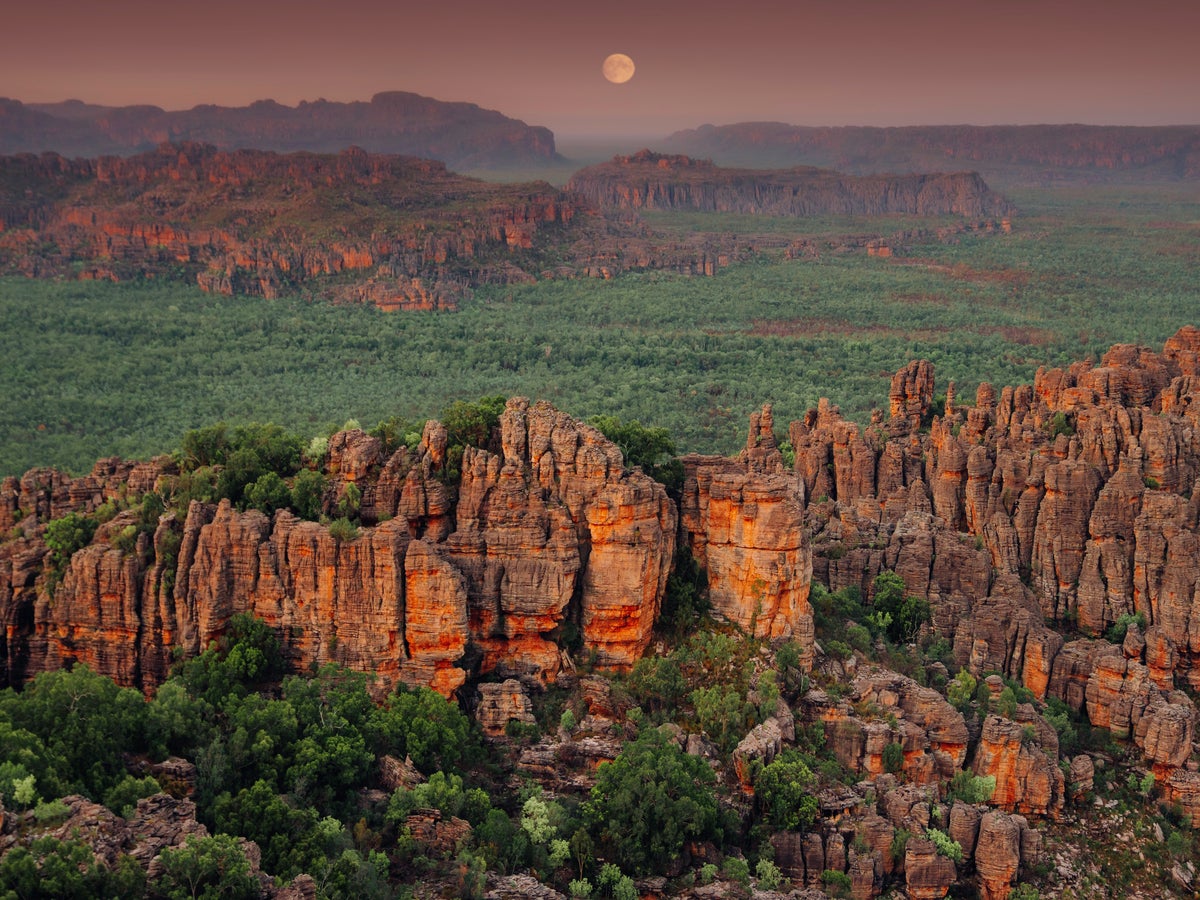
The park contains a remarkable variety of environments. There are vast floodplains, open woodlands, sandstone escarpments, monsoon forests, billabongs, rivers, and coastal areas.
The climate is strongly seasonal.
During the wet season, usually from around November to April, tropical rain can transform the landscape. Water spreads across the floodplains, waterfalls become powerful, and rivers rise through the lowlands.
During the dry season, the skies are often clear and the wetlands begin to shrink. Animals gather around the remaining water, while the golden grasses and red earth take on the colours associated with Australia’s tropical north.
These seasons are not simply changes in weather. They influence when people travel, hunt, fish, gather food, hold ceremonies, and care for the land.
For the Bininj/Mungguy people, the traditional owners of Kakadu, the year is understood through seasonal changes in plants, animals, water, wind, and fire.

Country and culture
Kakadu is Aboriginal land.
The Bininj people are generally associated with the northern parts of the park, while Mungguy is a term used in the southern areas. Different language groups and clans have long-standing relationships with particular parts of the country.
These relationships include responsibilities.
Country is not viewed merely as scenery or property. It is connected to identity, law, family, ceremony, ancestors, and the spiritual forces that shaped the world.
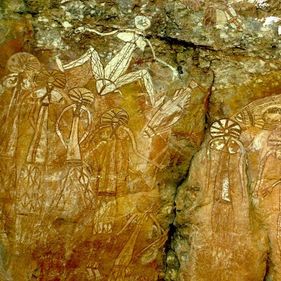
Creation stories explain the origins of landscapes, animals, people, and cultural responsibilities. At sites such as Ubirr and Burrunguy, also known as Nourlangie, these stories are connected to painted images and significant rock formations.
The paintings are therefore not just historical illustrations. They are part of a living cultural system.
Some knowledge associated with sacred places is not intended for public viewing or discussion. Visitors are asked to respect signs, closures, cultural instructions, and the guidance of Aboriginal rangers.
The ancient galleries of Kakadu
Kakadu has one of the world’s greatest concentrations of Aboriginal rock art.
Some paintings are up to 20,000 years old, while other images were created much more recently. Together, they form one of the longest continuous records of human activity found anywhere on Earth.
The art includes paintings of animals, human figures, ceremonial scenes, tools, weapons, and unfamiliar objects associated with encounters between Aboriginal people and outsiders.
At Ubirr, paintings are found beneath sandstone overhangs. The protected rock shelters provided shade and helped preserve the images from direct exposure to the elements.
The paintings were made with natural pigments, including ochre, charcoal, and other minerals. Artists used different techniques to create outlines, solid forms, patterns, and layers of imagery.
Some paintings were placed over earlier works. This means that the rock surfaces preserve multiple moments in time, with newer images appearing alongside or across older ones.
The art reveals much about the environment.
Animals such as fish, turtles, wallabies, goannas, and barramundi appear in the paintings. Their presence reflects the importance of hunting, fishing, observation, and ecological knowledge.
Other images record changes in technology and contact. Early paintings show traditional tools and animals, while later works include objects such as firearms, ships, and clothing associated with European arrival.
The rock walls became a kind of archive.
They recorded not only what people saw, but also what mattered to them.
Ubirr and the changing light
Ubirr is one of Kakadu’s best-known cultural sites.
Visitors walk through sandstone formations and rock shelters where paintings remain visible on the walls. The surrounding landscape contains floodplains and rocky outcrops, creating wide views across the country.
At sunset, the escarpment changes dramatically.
The rock becomes orange and gold, and the floodplains stretch toward the horizon beneath the fading light. The scene is beautiful, but its importance goes far beyond appearance.
Ubirr is a place where the landscape, the art, and the stories are connected. The rock shelters are not decorations placed in an empty wilderness. They belong to a cultural landscape shaped by generations of observation, ceremony, movement, and care.
To stand there is to see how a place can hold several kinds of time at once: geological time in the sandstone, ecological time in the wetlands, and human time in the paintings.
Burrunguy and the stories in stone
Burrunguy, often known as Nourlangie Rock, is another important site in Kakadu.
The shelters and rock faces contain paintings associated with ancestral figures and creation stories. One widely recognized figure is Namarrkon, the Lightning Man, who is connected with the electrical storms of the wet season.
The arrival of the wet season is one of the great events of life in Kakadu. Thunderstorms build over the escarpments, lightning cuts across the sky, and rain begins to fill the creeks and floodplains.
Stories such as those associated with Namarrkon connect weather with cultural law and ancestral power.
The paintings do not merely describe a storm. They express a relationship between people, Country, and the forces that sustain life.
Wildlife in a living wetland
Kakadu is home to an extraordinary range of animals.
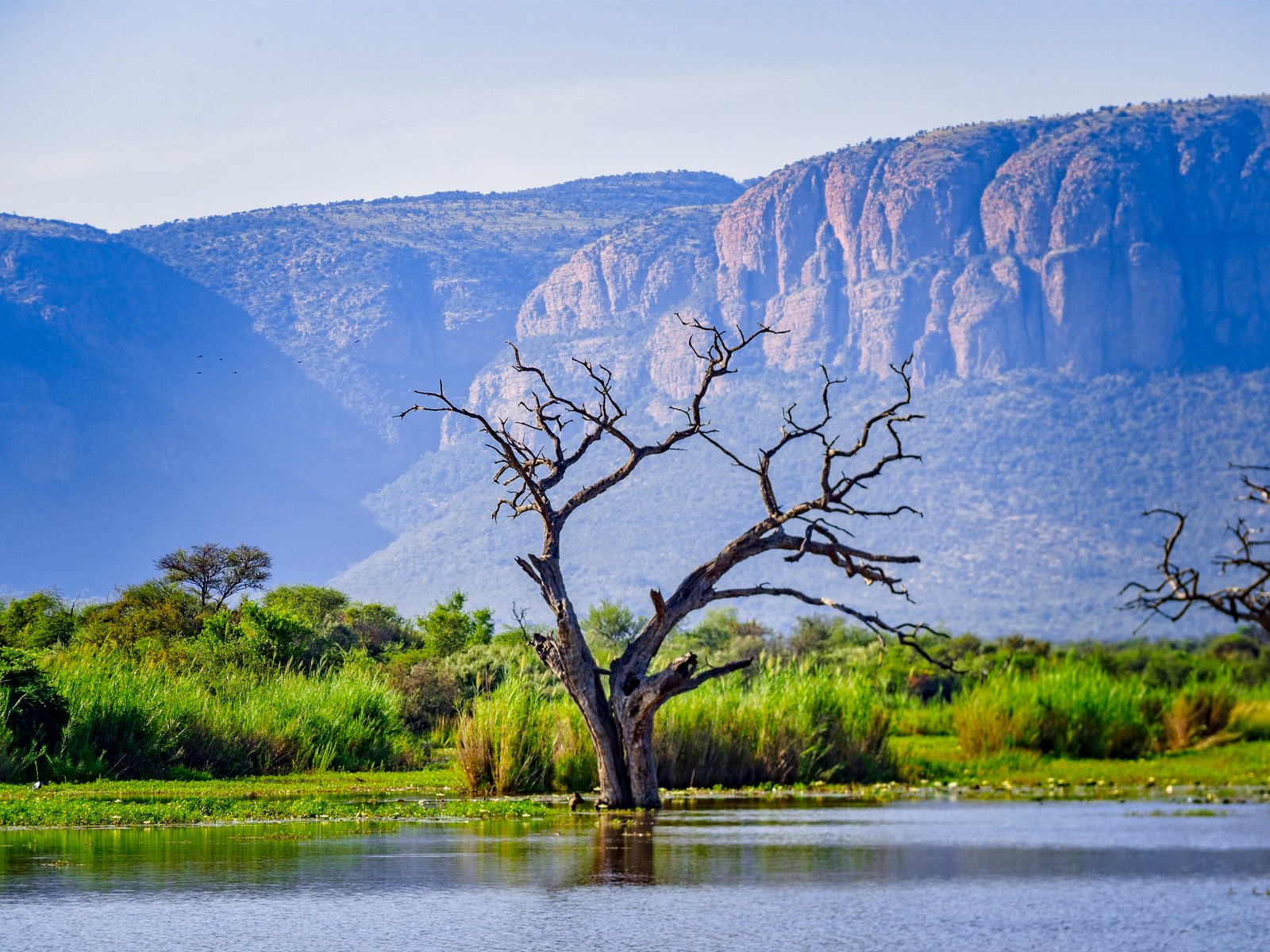
Its wetlands provide habitat for waterbirds, fish, amphibians, reptiles, and mammals. During the dry season, thousands of birds may gather around shrinking waters.
The park is particularly famous for its saltwater crocodiles.
These powerful reptiles live in rivers, billabongs, coastal waters, and wetlands. They are an important part of Kakadu’s ecosystem, but they also make careful visitor behaviour essential. Swimming is prohibited in many areas, and visitors must follow warning signs and park advice.
The wetlands are also home to magpie geese, jabirus, egrets, herons, kingfishers, and many other birds.
The changing water levels create different habitats throughout the year. Floodplains that appear empty in the dry season can become rich feeding grounds when the rains return.
This seasonal transformation is one of Kakadu’s defining features.
Fire and caring for Country
Fire has always played an important role in Kakadu.
Bininj/Mungguy people have used controlled burning as part of caring for Country. When undertaken at the appropriate time and in the right way, fire can reduce fuel loads, protect important areas, encourage fresh plant growth, and create a varied landscape that supports different animals.
Early dry-season burning tends to produce cooler, more controlled fires. Later in the dry season, vegetation becomes drier and fires can burn hotter and spread farther.
Traditional fire knowledge recognizes these differences.
Modern park management combines Aboriginal knowledge with scientific research, aerial observation, ecological monitoring, and practical land management. Aboriginal rangers play a major role in protecting cultural sites, managing fire, monitoring wildlife, guiding visitors, and maintaining connections between communities and Country.
This is one of the most important lessons of Kakadu: conservation is not only about excluding people.
In many landscapes, caring for nature depends on the knowledge and participation of the people who have lived with it for thousands of years.
The arrival of outsiders
European exploration and settlement brought profound changes to Kakadu.
Macassan trepang fishermen from what is now Indonesia had visited northern Australia for centuries before European colonization. Their contact with Aboriginal communities influenced trade, technology, language, and cultural exchange.
European explorers and settlers later entered the region, followed by missionaries, miners, pastoralists, government officials, and tourists.
The arrival of outsiders introduced new diseases, economic pressures, restrictions, and disruptions to Aboriginal life. Aboriginal people were displaced from some areas, and traditional access to Country was limited by government policies.
The history of Kakadu therefore includes both cultural survival and injustice.
Aboriginal communities continued to maintain knowledge, language, ceremony, and identity despite enormous pressure. Today, the park’s management and interpretation increasingly recognize Aboriginal authority, history, and cultural knowledge.
Mining and the creation of the park
Kakadu’s modern history also includes a major debate about mining.
Uranium deposits were discovered in the region, and mining began at Ranger in the late twentieth century. The mine became one of Australia’s most significant uranium operations.
At the same time, there was growing support for protecting Kakadu’s environmental and cultural values.
Kakadu National Park was declared in stages beginning in 1979. Its boundaries expanded through later stages, although some mining areas were excluded from the park itself.
The region’s cultural and natural importance was recognized internationally. Kakadu was listed as a UNESCO World Heritage Site for its natural values in 1981 and later recognized for both cultural and natural significance.
The park became one of the world’s few dual-listed World Heritage places.
The mining debate revealed a difficult question: how can a country protect Aboriginal cultural landscapes and extraordinary ecosystems while also managing economic interests and existing agreements?
There has never been an easy answer.
Kakadu’s history demonstrates that conservation involves law, politics, community rights, cultural responsibility, and long-term environmental decisions.
A place that is still alive
It can be tempting to think of national parks as untouched places, preserved exactly as nature created them.
Kakadu challenges that idea.
The park has been shaped by Aboriginal people for tens of thousands of years. Paths, camps, food-gathering places, ceremonial areas, paintings, fire practices, and stories are all part of its history.
The landscape is natural, but it is also cultural.
This does not make it less wild. It makes the meaning of “wild” more complicated. Kakadu shows that human presence and environmental protection do not always have to be opposites.
The deeper question is how people live in a place and what responsibilities they accept toward it.
The enduring power of Kakadu
Kakadu is beautiful in ways that are immediately visible.
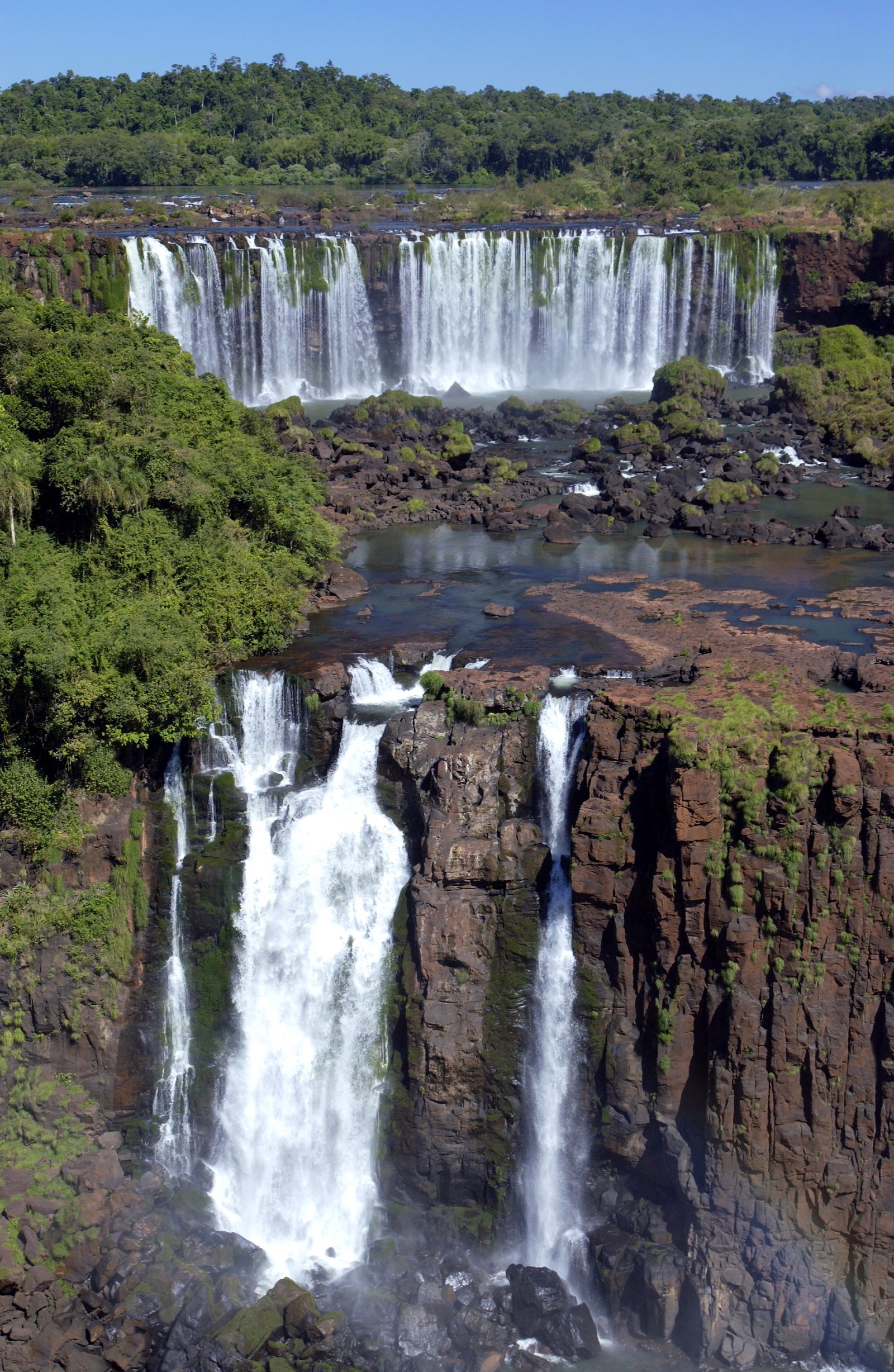
There are waterfalls falling from high escarpments, wetlands reflecting clouds, red cliffs glowing in the evening, and forests alive with birdsong. But the greatest beauty of Kakadu is deeper than scenery.
It is the continuity of the place.
The same seasonal rains still move across the floodplains. The same animals still gather around water. The same escarpments still rise above the country. The same cultural stories continue to connect people with land, ancestors, weather, animals, and responsibility.
The paintings on the rock walls remind visitors that history is not always found in books.
Sometimes it is found in a shelter beneath sandstone. Sometimes it is heard in the thunder of the wet season. Sometimes it is visible in a ranger lighting a careful fire or guiding visitors through a place with respect.
Kakadu is not simply a park filled with old things.
It is a living place, still changing, still cared for, and still speaking through its rocks, rivers, animals, and people.