
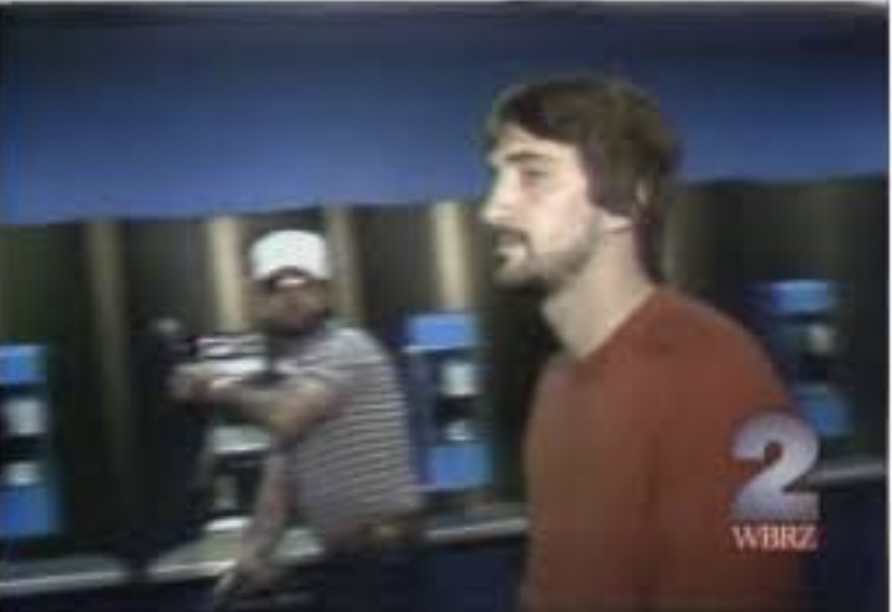
On March 16, 1984, a television camera was waiting inside the Baton Rouge airport in Louisiana.
The station was there because a kidnapping suspect was being brought back to the United States. Reporters expected a routine arrest: a handcuffed man arriving under police escort, cameras recording the beginning of a criminal case.
Then Gary Plauché appeared.
He was the father of eleven-year-old Jody Plauché, a boy who had been sexually abused and taken across state lines by his karate instructor, Jeffrey Doucet. For weeks, Gary had lived with the terror of not knowing where his son was. When Jody was finally found in California and Doucet was arrested, the family expected the legal system to take over.

But grief and rage do not always disappear when a child is brought home.
Sometimes they remain in the room.
The airport scene unfolded quickly. Doucet was escorted through the terminal by police officers. He was not expecting an attack. He was walking past a bank of cameras when Gary stepped forward and fired a single shot.
The sound echoed through the airport.
Doucet fell. The camera kept recording.
The footage was broadcast across the country, turning a private family tragedy into one of the most disturbing televised moments in American crime history. There was no dramatic chase, no warning, and no cinematic confrontation. Just a father, a gun, a crowded airport, and a decision that could not be taken back.
Gary Plauché was arrested immediately.
For many people watching the footage, the reaction was complicated. Some saw a grieving father who had been pushed beyond the limits of endurance. Others saw a man who had committed a public killing and bypassed the courts. The question became impossible to avoid: when a child has been harmed, does a parent’s fury explain an act of violence, or does it ever justify it?
The story became even more unsettling because the shooting happened in front of cameras. The world witnessed the moment without seeing the months of fear that had come before it. Viewers saw the gunshot, but not the sleepless nights. They saw the airport, but not the panic of a family searching for a missing child. They saw a killing, but not the private damage that had already been done.
That difference matters.
The case is often repeated as a story of revenge, but revenge is only one part of it. At its center was Jody, a child who had survived abuse and kidnapping, then had to live with the knowledge that his father had killed the man responsible. The event did not erase what happened to him. It did not return his childhood. It did not make the fear disappear.
Instead, the violence created another permanent memory.
In the aftermath, Gary Plauché faced the courts. He eventually pleaded no contest to manslaughter and received probation rather than a prison sentence. The decision drew enormous public attention and divided opinion. To some, it represented compassion toward a devastated parent. To others, it sent a dangerous message about taking the law into one’s own hands.
But no courtroom could produce a clean ending.
There was no sentence capable of repairing the family. No verdict could make Jody untouched by what had happened. No television broadcast could show the full story, because the most important parts of it were invisible: the psychological damage, the loss of trust, the confusion, and the years required to survive the aftermath.
That is what makes the airport footage so haunting.
It is not only the image of a father shooting the man accused of abusing his son. It is the moment when private suffering became public spectacle. The camera recorded a fraction of a second, but that second carried the weight of an entire family’s nightmare.
The scene has been replayed for decades, often accompanied by arguments about whether Gary Plauché was a hero, a criminal, or something more complicated. Those labels may be easy to use, but the reality is not easy at all.
A parent’s instinct to protect a child is powerful. So is the demand that serious crimes be handled through a justice system rather than personal retaliation. Both truths exist at the same time. Recognizing the horror of what happened to Jody does not require celebrating the shooting. And condemning the shooting does not require ignoring the unbearable pain behind it.
The most important person in this story was never the gunman or the man he killed.
It was the child left to carry the consequences.
Years later, Jody Plauché spoke publicly about his experience and used his story to help others understand child abuse, trauma, and survival. His life did not end at the airport. That matters. The footage may freeze one violent moment forever, but it does not define everything that came afterward.
The cameras captured the shot.
They did not capture the years of healing. They did not capture the difficult conversations. They did not capture the child becoming an adult and reclaiming his own story.
That is where the real ending lies.
Not in the airport. Not in the gunshot. Not in the arguments over whether revenge was justified.
The real ending is found in the fact that Jody survived something designed to silence him, and eventually spoke in his own voice.
A father entered an airport carrying rage.
A camera captured the consequence.
But the survivor was the one who had to live beyond it.